Thursday, March 04, 2021

Getting ITILV4 Certified

 A lot has changed in ITIL , since I lasted certified on ITIL v2. What was earlier a library of best practices and process for running IT service management, with ITIL v4, it takes a holistic approach and everything is aligned strategically with focus on on value and keeping in tune with changes in IT domain in terms of cloud and AGILE practices.

ITIL 4 puts service management in a strategic context. It looks at ITSM, Development, Operations, business relationships and governance holistically and brings the different functions together. By doing this, ITIL 4 has evolved into an integrated model for digital service management.

Now coming to taking up the certification.

Simplilearn is official training partner in Bangalore, you can enroll for their course, I got an offer from them with the e-training and voucher for around Rs.15K (with GST).

The e-course is OK. I found the training video on youtube by Nooreddin Tahayneh useful,though the whole of course is not free as slides in videos are blurred out.

Complete playlist.

https://www.youtube.com/playlist?list=PLU0hwmH1hdn1kN22e6EW_W0uzVbJy11nR

And also a udemy course for practice tests by the same author is very useful.

https://www.udemy.com/share/103JpQAkEdcFZUQnw=/

Looks like the udemy course doesn't exist any more , you can buy the practice exam on https://certibanks.com/Course_details.aspx?id=1

I used the Simplilearn e-course and then did the youtube video and practice tests.

I got a decent score of  88% just 5 questions wrong out of 40.

Hope this is useful for people who are planning to take up the ITIL v4 Foundation level certification.

Wednesday, September 09, 2020

What is database sharding?

Database sharding is the process of making partitions of data in a database or search engine, such that the data is divided into various smaller distinct chunks, or shards.

Each shard could be a table, a Postgres schema, or a different physical database held on a separate database server instance.

svg viewer

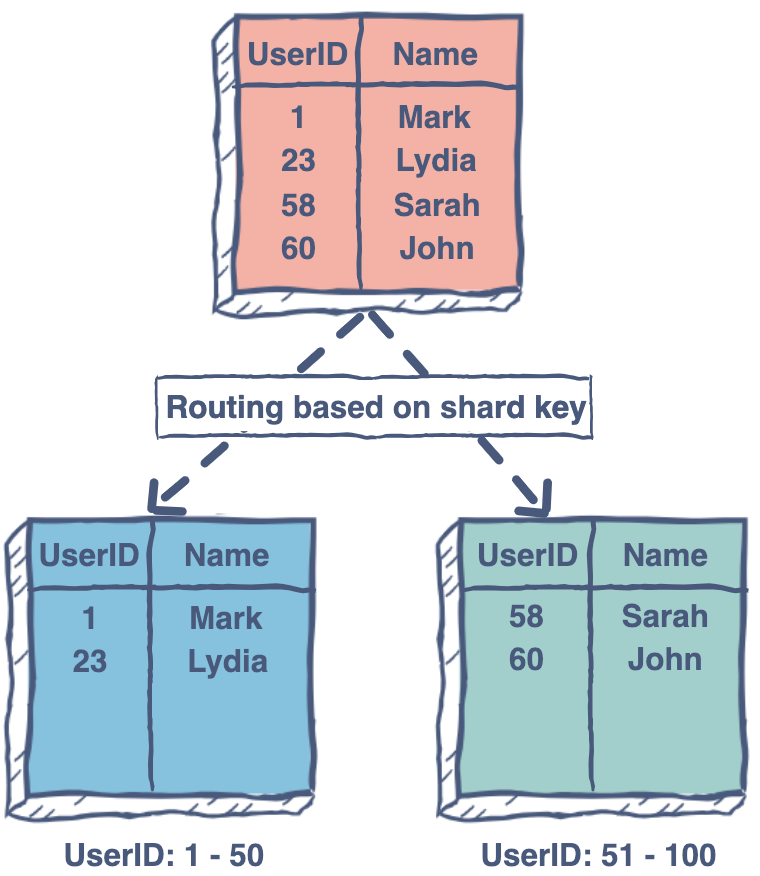
Some data within the database remains present in all shards (vertical sharding), but some appear only in single shards (horizontal sharding). The following figure illustrates vertical sharding and horizontal sharding.

To shard your data, you need to decide a key, called a sharding key, to partition your data on. The shard key is either an indexed field or indexed compound fields that exist in every document in the collection.

There is no general rule to select a sharding key; what key you choose depends on your application. For instance, you may choose userID as the shard key in a social media app.


Markdown Monster icon

Sharding allows your application to make fewer queries. When it receives a request, the application knows where to route the request and thus it has to look through less data, rather than going through the whole database.

It improves the performance of your application, and lets you rest easier, not having to worry about scalability issues.


License: Creative Commons -Attribution -ShareAlike 4.0 (CC-BY-SA 4.0)